
Top 10 Butterfly Pea Powder Suppliers Worldwide?
Butterfly Pea Powder is moving from regional herbal kitchens into functional beverages, bakery mixes, cosmetics, and natural color applications. Its vivid blue tone comes mainly from anthocyanins called ternatins. Yet brightness alone does not prove quality, safety, or nutritional value.
Grand View Research and IMARC Group both identify natural colors and botanical ingredients as expanding global markets. Mintel and Innova Market Insights also report stronger consumer interest in recognizable, plant-based ingredients. However, public reports often combine butterfly pea with broader natural-color categories. Direct market figures should therefore be read carefully. The numbers are useful, but not perfectly comparable.
Dr. Chusak Chumroenphol, whose research examines butterfly-pea beverages and anthocyanins, has emphasized that processing conditions can influence color stability and antioxidant performance. In practical terms, “Color is not proof of health value.” That distinction matters when comparing suppliers. A reliable producer should provide botanical identification, origin details, moisture limits, microbial testing, pesticide screening, and batch-level certificates of analysis.
Supplier experience also matters. Powder stored in a clear bag may fade under warehouse light. Excess humidity can create clumps and weaken dispersibility. Some suppliers offer laboratory data, but documentation may vary between batches. That is an imperfect reality.
This guide reviews ten Butterfly Pea Powder suppliers worldwide, focusing on sourcing transparency, processing capability, certifications, packaging, customization, and export experience. Buyers should still verify current certificates directly. Claims change. Supply chains do too.
What Is Butterfly Pea Powder and Why Is It Globally Sourced?
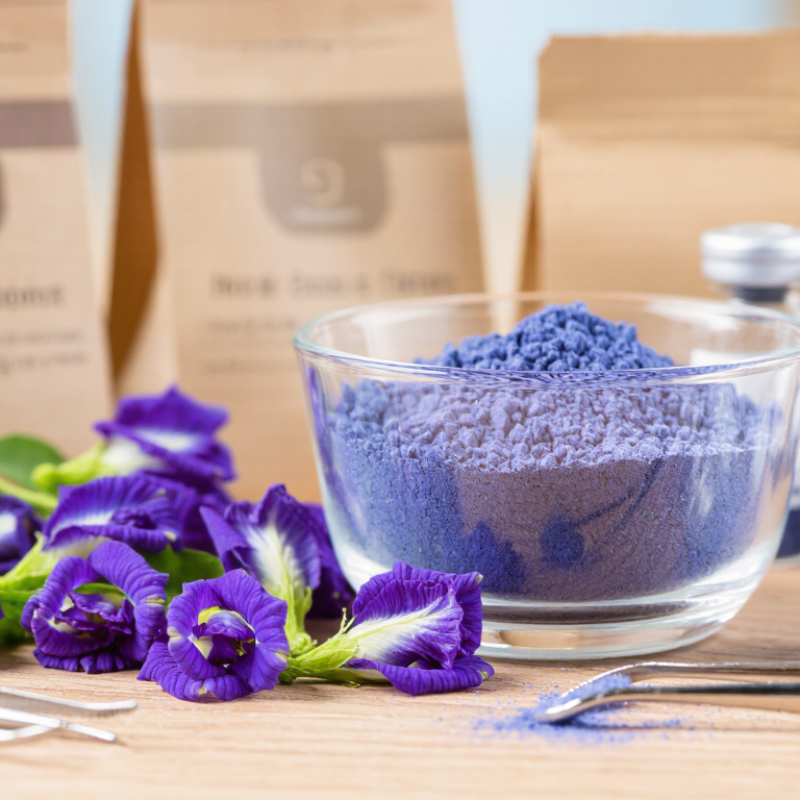
Butterfly pea powder comes from the dried flowers of Clitoria ternatea, a blue-flowering legume native to Southeast Asia. Its vivid color comes mainly from anthocyanins, especially ternatins. When mixed with lemon juice, the powder can shift from deep blue toward violet or pink. That visible reaction makes it useful in teas, bakery products, beverages, and natural color systems.
Global sourcing reflects both climate and processing needs. The plant grows well in warm, humid regions, while drying quality depends on sunlight, moisture control, and storage. Grand View Research estimates that the global natural food colors market reached about USD 1.9 billion in 2023, with continued growth expected through 2030. However, major reports rarely separate butterfly pea powder from broader botanical color categories. That gap matters. Market rankings can look more precise than the available evidence.
A reliable supplier should provide botanical identity testing, moisture results, microbial analysis, and pesticide documentation. Buyers should also ask whether flowers are hand-sorted, low-temperature dried, and milled in food-grade facilities. The FAO emphasizes traceability and quality controls across food supply chains, while Codex guidance supports documented hygiene practices. I would not judge suppliers by color intensity alone. Bright powder may reflect freshness, but it does not prove purity or stable anthocyanin content. The top ten list is therefore better viewed as a sourcing starting point, not a permanent global verdict.
| Position | Major Sourcing Market | Typical Supplier Profile | Primary Raw Material | Common Commercial Formats | Key Natural Characteristics | Typical Buyer Segments | Common Documentation Requested | Global Sourcing Strength |
|---|---|---|---|---|---|---|---|---|
| 1 | Thailand | Established botanical ingredient processors and export-oriented agricultural suppliers | Whole blue flowers of Clitoria ternatea | Fine powder Dried flowers Water-soluble extract | Blue-to-purple color response, mild flavor, and naturally occurring ternatin pigments | Tea, beverage, bakery, confectionery, supplements, and natural-color applications | Certificate of analysis, microbiological report, pesticide-residue test, allergen statement, and origin declaration | Very strong |
| 2 | India | Herbal ingredient manufacturers, spice processors, and agricultural exporters | Blue butterfly pea flowers cultivated in tropical and subtropical regions | Organic powder Conventional powder Flower extract | Natural anthocyanin-rich blue color and a generally mild botanical aroma | Ayurvedic products, functional beverages, herbal teas, food supplements, and personal care | Organic certificate where applicable, heavy-metal test, pesticide test, GMP evidence, and product specification | Very strong |
| 3 | Vietnam | Smallholder-linked agricultural processors and dried-herb export suppliers | Air-dried or low-temperature-dried butterfly pea flowers | Flower powder Tea-cut flowers Extract powder | Bright blue color potential when protected from excess heat, light, and moisture | Tea blends, ready-to-mix beverages, dessert products, and wellness formulas | Moisture specification, microbial testing, pesticide-residue report, traceability records, and packaging details | Strong |
| 4 | Malaysia | Food-ingredient distributors and regional botanical-product processors | Locally cultivated flowers and imported raw materials processed for Southeast Asian markets | Spray-dried color powder Instant drink ingredient Dried flowers | Suitable for color-focused beverage and dessert applications; color changes with pH | Halal food products, beverages, bakery, desserts, and nutraceutical formulations | Halal documentation, food-safety certification, certificate of analysis, and contaminant testing | Strong |
| 5 | Indonesia | Herbal-product suppliers, tea producers, and natural ingredient exporters | Dried blue flowers from tropical cultivation areas | Loose flowers Ground powder Herbal tea blends | Distinctive blue infusion, mild taste, and purple or pink tones after acidification | Herbal teas, cafés, beverage concentrates, cosmetics, and traditional botanical products | Microbiological analysis, moisture content, botanical identity, origin statement, and packaging compliance | Strong |
| 6 | Sri Lanka | Tea and spice exporters adding specialty botanical ingredients to their portfolios | Sun-dried or mechanically dried butterfly pea flowers | Tea-grade flowers Powder Blended botanical ingredients | Useful as a caffeine-free herbal infusion and natural blue coloring ingredient | Tea businesses, wellness brands, hospitality, beverage makers, and specialty food producers | Phytosanitary documents, certificate of analysis, pesticide testing, moisture report, and traceability information | Moderate to strong |
| 7 | Philippines | Community-based growers, herbal processors, and specialty natural-food suppliers | Fresh flowers processed into dried botanical material | Dried flowers Powder Tea sachet material | Strong visual appeal in blue beverages and naturally pH-responsive color behavior | Local beverages, cafés, herbal products, foodservice, and small-batch natural foods | Food establishment registration, microbial testing, product specification, and export documentation where required | Moderate |
| 8 | China | Large-scale botanical extract manufacturers and ingredient trading companies | Domestic and imported butterfly pea flowers processed into standardized ingredients | Standardized extract Spray-dried powder Bulk botanical powder | Broad processing capability, consistent particle size, and scalable packaging options | Food manufacturing, supplements, cosmetics, research, and private-label products | Full specification sheet, assay or color-value data, heavy-metal testing, pesticide report, and factory audit documents | Strong processing capacity |
| 9 | Australia | Specialty native-botanical and premium natural-ingredient suppliers | Controlled or small-scale cultivation of butterfly pea in warm regions | Premium powder Dried flowers Retail-ready packs | Emphasis on traceability, clean-label positioning, and premium presentation | Specialty tea, gourmet food, wellness products, hospitality, and direct-to-consumer retail | Australian food-safety documentation, traceability records, allergen statement, and batch certificate | Moderate, premium-focused |
| 10 | East Africa and Other Tropical Origins | Emerging growers, cooperative processors, and specialty export traders | Regionally cultivated Clitoria ternatea flowers suitable for drying | Dried flowers Basic powder Custom bulk lots | Potentially competitive agricultural supply with increasing interest in botanical exports | Herbal tea, natural ingredients, local food processing, and specialty importers | Phytosanitary certificate, certificate of analysis, pesticide testing, moisture report, and supply-chain traceability | Emerging |
| Product note: Butterfly pea powder is made by drying and milling the flowers of Clitoria ternatea, a tropical legume. Its naturally occurring anthocyanin pigments can appear blue in neutral conditions and shift toward purple or pink as acidity increases. Supplier suitability depends on botanical identity, drying method, color stability, microbiological quality, pesticide compliance, certifications, minimum order quantity, and destination-country regulations. The positions above represent practical sourcing-market relevance rather than an official global ranking of individual companies. | ||||||||